

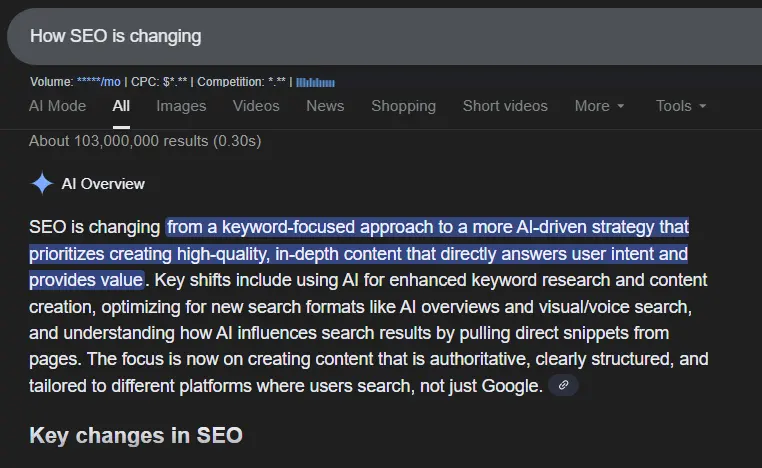
Search is undergoing one of its biggest transformations in decades. In the past, SEO focused mainly on helping websites rank higher in traditional search results. Marketers relied on keywords, backlinks, and technical optimizations to improve visibility on Google.
Today, with AI-powered tools like ChatGPT, Perplexity, and Google AI Overviews, users are increasingly engaging with summarized, conversational answers that often bypass websites entirely.
This new shift introduces a layer of optimization focused on AI-driven search. Traditional SEO still matters, but AI SEO determines whether your content is understood, trusted, and cited by AI systems.
In this article, we’ll explain how traditional SEO and AI SEO complement each other, what makes AI SEO unique, and how businesses can adapt to stay visible in this AI-driven landscape.
Understanding AI SEO: What It Is and Why It Matters
AI SEO is the practice of optimizing content so that it can be discovered, interpreted, and referenced by AI-powered search tools like ChatGPT, Perplexity, and Google AI summaries.
Some marketers call it Generative Engine Optimization (GEO) or Answer Engine Optimization (AEO), but the goal is the same: making content easily understood and citable by AI systems.
Both traditional SEO and AI SEO are essential:
- Traditional SEO ensures your website ranks high in standard search results.
- AI SEO ensures your content appears in AI-generated answers and summaries.
Together, they maximize visibility across all search formats
How AI Search Works Behind the Scenes
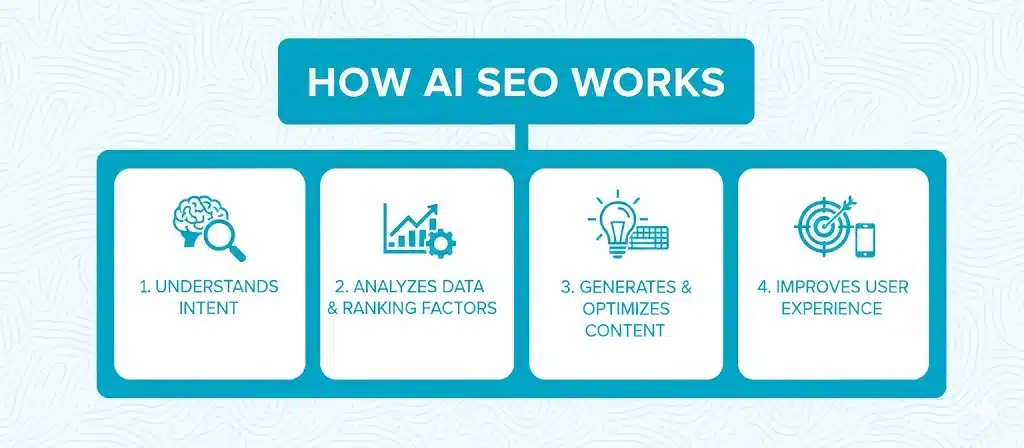
AI-driven search tools still crawl websites to discover content — but they process it differently than traditional search engines. Instead of simply ranking pages by keywords or backlinks, AI reads, interprets, and blends content to create a single, concise answer.
AI evaluates content based on:
- Meaning, not just keywords – Understanding context, intent, and relationships between entities (like people, organizations, or concepts).
- Authority and trust signals – Credibility is key. Clear authorship, cited sources, structured data, and consistent online reputation strengthen trust.
- Original data and genuine reviews – AI favors content backed by first-party information and authentic customer feedback.
- Extractable snippets – Short, clear, and structured fragments like paragraphs or bullet points are more likely to be used in AI-generated answers.
In short, AI SEO is about making content readable, reliable, and reusable by machines
Optimizing for AI: Key Takeaways
Optimizing for AI doesn’t replace traditional SEO — it builds on it. The same basics (fast websites, high-quality content, backlinks) still matter, but AI adds new factors for discovery and citation.
Clarity and Structure Matter
AI prefers content that’s easy to parse:
- Clear headings
- Short paragraphs
- Logical flow
- Key takeaways upfront
This makes it easier for AI systems to segment and summarize your content.
Context Over Keywords
Use context-rich language. Mention people, organizations, products, and explain how they relate. AI looks for entity relationships, not just isolated keywords.
Authority Through E-E-A-T
Experience, Expertise, Authority, and Trustworthiness are even more critical in AI SEO. Make sure your:
- Author bios are detailed
- Credentials and certifications are visible
- Publication dates are up-to-date
- Brand expertise is consistent across the web
Behind-the-Scenes Structure
Schema markup helps AI understand your content. Use it for:
- FAQs
- How-to guides
- People & organizations
- Products & services
- Reviews & testimonials
Collaborate with a web developer if needed.
Monitor AI Representation
Check how your content appears in AI tools like ChatGPT and Google AI summaries. Update formatting or phrasing if summaries are incomplete or inaccurate. Treat this as a new layer of performance analytics.
Traditional SEO Still Plays a Role
While AI introduces new factors, traditional SEO fundamentals remain important:
- Technical SEO: Fast load times, mobile-friendliness, and crawlable architecture.
- Content depth: Comprehensive, high-quality articles provide context for AI.
- Backlinks and mentions: Links from credible sites boost authority and trust.
- User engagement: Longer on-page time signals relevance.
- Topical consistency: Clear internal linking and structured content enhance expertise.
Combining traditional SEO with AI SEO creates a robust digital strategy.
Getting Started With AI-Ready SEO
If you’re ready to adapt your site for AI-driven search, follow this checklist:
These steps help ensure your content remains discoverable, credible, and citable as search evolves.
- Allow AI crawlers – Ensure bots like GPTBot and ClaudeBot can access your content.
- Add FAQ content – Well-structured FAQs improve AI discoverability.
- Update employee profiles – Include awards, credentials, publications, and expertise.
- Use schema markup – Highlight FAQs, staff bios, organizations, products, and reviews.
- Monitor AI visibility – Track how your content is represented in AI platforms.
The SEO landscape is changing. Traditional methods still matter, but AI-driven search is creating new opportunities for businesses that want to stay visible.
FAQs About AI, AI-Driven Processes, and SEO
How has AI progressed from traditional AI to generative AI?
- Traditional AI focuses on rules-based systems, predictions, and task automation. It relies on structured data and predefined algorithms to solve problems.
- Generative AI goes further: it can create new content — text, images, code, audio — by learning patterns from large datasets. Examples include ChatGPT, DALL·E, and music-generation models.
- Progression: From AI that analyzes or predicts → to AI that creates and generates new, human-like outputs.
What is the AI-driven gene therapy process?
AI-driven gene therapy uses artificial intelligence to design, optimize, and deliver gene-editing treatments.
- Step 1: AI analyzes genetic data to identify disease-causing genes.
- Step 2: AI helps design precise gene-editing tools (like CRISPR guides).
- Step 3: AI predicts treatment outcomes and personalizes therapy for patients.
- Step 4: AI monitors and optimizes treatment delivery and effectiveness.
This accelerates research and improves safety and efficiency in gene therapy.
What is the 30% rule for AI?
The “30% rule” in AI often refers to limiting automation or reliance on AI to about 30% of a process until full validation or testing.
- It’s a cautionary guideline to prevent overdependence on AI without human oversight.
- It’s not a universal law but is often used in AI ethics, healthcare, and business applications.
What does AI-driven mean?
- AI-driven means a process, system, or decision-making method is powered or guided by artificial intelligence.
- Example: AI-driven marketing uses AI to analyze data and automatically optimize campaigns.
- Essentially, AI is the main engine behind the action or decision.
Is SEO going to be replaced by AI?
- No, SEO won’t disappear, but it is evolving.
- AI changes how search works (generative answers, summaries, and AI chatbots), so SEO strategies must adapt:
- Focus on content clarity, context, and authority
- Optimize for AI citations and snippets
- Traditional SEO and AI SEO will work together rather than one replacing the other.
How is SEO changing in 2026?
Key trends in SEO for 2026:
- AI-driven search: Content must be optimized for generative answers.
- User intent over keywords: Context-rich content becomes critical.
- E-E-A-T signals: Experience, Expertise, Authority, Trustworthiness matter more.
- Structured data & schema: Helps AI understand your content.
- Voice & visual search: Optimizing for conversational queries and images/videos.
What are the 4 pillars of SEO?
The 4 core pillars of SEO are:
- Technical SEO – Site speed, mobile-friendliness, crawlability, security.
- On-Page SEO – Keywords, headings, content structure, metadata.
- Off-Page SEO – Backlinks, citations, brand mentions.
- Content & User Experience – High-quality content, user engagement, clear navigation
Looking to dominate local search? Connect with Maps SEO Services, and discover how our Maps SEO experts can help your business show up in front of the right customers.