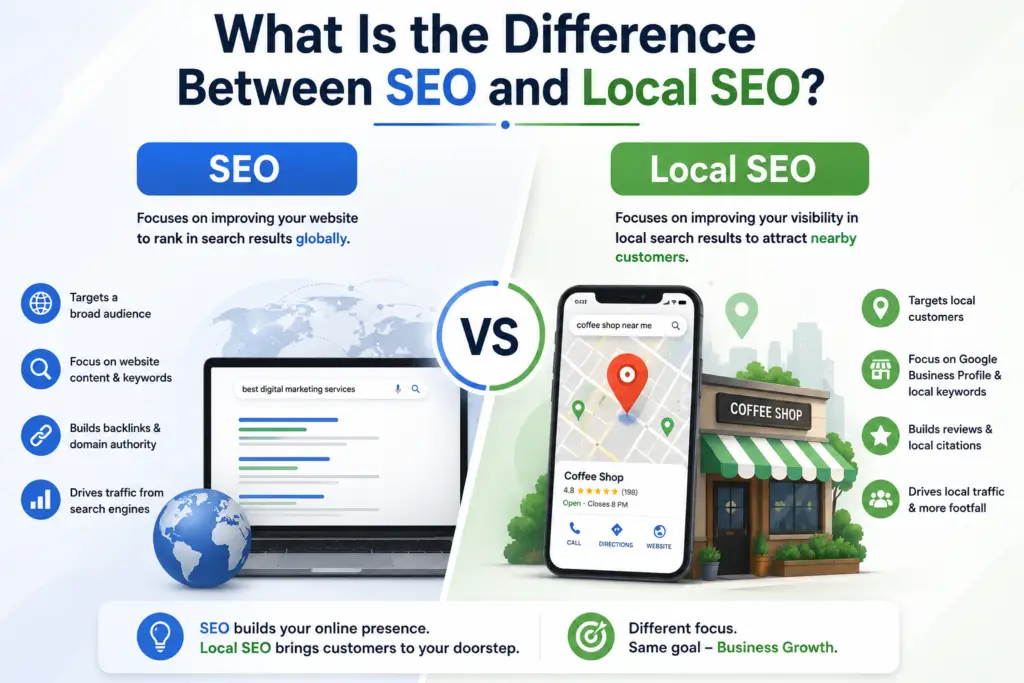
Not all SEO works the same way. A national ecommerce brand and a neighborhood plumber might both be “doing SEO,” but they’re chasing completely different customers, competing in different results, and measuring success in different ways. Lump them into the same strategy and one of them ends up wasting time and budget on the wrong things.
That’s the real distinction between SEO and local SEO — not two competing tactics, but two different scopes built for two different kinds of businesses. Knowing which one your business actually needs (or how much of each) can save you from months of effort aimed at the wrong audience.
What Is SEO?
SEO, or search engine optimization, is the process of improving a website so it ranks higher in organic search results for relevant keywords. The goal is simple: get in front of more of the right people when they search — and turn that visibility into traffic, leads, or sales.
Traditional SEO isn’t tied to one city or region. A software company might optimize for terms like “project management software” or “customer relationship management tools,” knowing their buyers could be searching from anywhere in the country, or the world.
This kind of SEO typically includes keyword research, on-page optimization, technical SEO, content creation, internal linking, site performance, and backlink-driven authority building. The exact mix depends on the industry, the competition, and what the business is actually trying to achieve — but the common thread is that it isn’t built around geography.
What Is Local SEO?
Local SEO is a focused branch of SEO built around one thing: geographic intent. It’s how businesses show up when someone searches for a product or service near a specific place — a city, a neighborhood, or “near me.”
Someone searching “plumber near me,” “plumber in Austin,” or “emergency plumbing services in Austin” isn’t browsing casually — they’re looking for a business that can actually reach them. Local SEO is what puts your business in front of that person, whether that shows up as an organic result, a spot in the Local Pack, or a pin on Google Maps.
It’s especially valuable for businesses that depend on customers walking through a door or booking a service in a defined area — restaurants, electricians, HVAC companies, dentists, law firms, cleaning services, contractors, and real estate agents, among many others.
The Core Difference: Audience and Geography
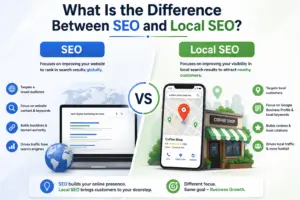
At its heart, the difference between SEO and local SEO comes down to who you’re trying to reach and where they’re searching from.
Traditional SEO is built to capture searches that could come from anywhere. Local SEO is built around searches where location is part of the decision itself. Take the keyword “running shoes” versus “running shoes in Dallas” — the first could apply to a customer anywhere in the country; the second tells you exactly where that customer needs to be served.
Both approaches share the same underlying SEO principles. Local SEO simply layers on additional signals — geographic relevance and local trust — that traditional SEO doesn’t need to worry about.
Where the Focus Shifts: Website vs. Geography
Traditional SEO puts most of its weight on the website itself: making it fast, technically sound, relevant, and authoritative. That means keyword research, content optimization, technical fixes, internal linking, backlink building, and a genuinely good user experience. Businesses targeting a national or global audience lean heavily on this, since their customers could be logging in from anywhere.
Local SEO still requires a solid website, but it goes a step further by building signals that tell search engines exactly where a business operates and who it actually serves. That includes Google Business Profile optimization, citation building, review management, location-specific content, and local backlinks. The goal isn’t just more website visitors — it’s the right visitors, the ones close enough to actually become customers.
Why Google Business Profile Changes Everything
This is one of the clearest lines between the two disciplines. A website can rank well in organic search without any connection to Google Business Profile. But if a business wants to show up on Google Maps or in the Local Pack, a properly managed profile isn’t optional — it’s the foundation.
A strong profile needs accurate business information, the correct primary category, a clear list of services, up-to-date hours, real photos, and consistent review activity. For any local business, this profile shouldn’t be treated as a side project — it needs to work in tandem with the website, not sit off to the side as an afterthought.
Keyword Strategy Isn’t the Same Either
Keyword research matters for both approaches, but the target looks different. Traditional SEO often chases broader or informational terms — “how to improve website traffic” or “best accounting software” — where the audience could be anyone, anywhere.
Local SEO usually centers on location-based terms like “local SEO services in Austin” or “dentist near me.” It’s worth noting that plenty of local searches don’t include a location at all — Google infers intent from the searcher’s device location and other signals. That means local businesses need to optimize for both what they offer and where they offer it, without stuffing city names into content unnaturally.
Citations Build Local Trust
A citation is any mention of your business name, address, and phone number on an outside platform — think directories, review sites, and industry listings. Consistent, accurate citations reinforce your business’s identity and location in the eyes of search engines.
Traditional SEO leans on backlinks to build website authority. Local SEO uses both backlinks and citations, but the priority is accuracy and relevance over sheer volume — a handful of listings on trustworthy, relevant platforms will do more for you than dozens of low-quality directory submissions.
Reviews Carry More Weight Locally
Reviews influence every business to some degree, but they carry outsized weight for local ones. When someone’s choosing between the three plumbers that show up in a map search, reviews are often the deciding factor — and a business with a thin or negative review profile is at a real disadvantage next to a competitor with dozens of recent, positive ones.
The right approach is straightforward: ask genuine customers for honest feedback, respond to reviews professionally, and never resort to fake reviews or incentivized ratings — a shortcut that tends to backfire on trust and rankings alike.
Which One Does Your Business Actually Need?
It comes down to where your customers are. A business selling to a national or global market benefits most from traditional SEO. A business drawing customers from a specific city or service area needs local SEO front and center.
Plenty of businesses need both. A law firm might publish broad, helpful legal content through traditional SEO while relying on local SEO to rank for “legal services in [city].” A company with several physical locations often needs a strong core SEO strategy for its main site, paired with a dedicated local strategy for every individual location.
SEO and Local SEO Work Better Together
These aren’t rival strategies — they’re complementary ones. Website SEO builds the overall quality, relevance, and authority that every search engine rewards. Local SEO adds the geographic layer that connects that authority to real, nearby customers.
For most local service businesses, the strongest results come from combining technical SEO, service page optimization, local landing pages, Google Business Profile management, citation building, review management, local link building, and genuinely useful content — not choosing one lane and ignoring the other.
Final Thoughts
The real difference between SEO and local SEO isn’t about which one is “better” — it’s about intent, geography, and who your business is actually trying to reach. Traditional SEO builds visibility across the open web. Local SEO builds visibility in the specific places your customers already are.
For local businesses, leaning only on traditional SEO means leaving Google Maps and local search results largely uncontested. The strongest local strategies bring both together: a solid, well-optimized website paired with an actively managed Google Business Profile, consistent citations, real reviews, and local content that speaks to the exact audience you’re trying to reach.